UX & Service Design
Music can still be enjoyable after 8 hours
Leading design for the Apple Music and internal workforce teams, I conducted and coordinated research, design, validation, and testing as the design team's lead, and coordinated with the community, internal, and Apple workforces to measure behavior, output, sentiment, and productivity.
The problem
Problem 1: turn a manual, resource-intensive process into a profitable, automated, tech-enabled powerhouse. Problem 2: reduce the negative effects of the repetitive task of transcribing music lyrics. For hourly-paid lyric transcribers, 8 hours of listening to music, countless rewinds to hear difficult-to-understand phrases, and having 10 different genres of 20 different songs spinning around in your head quickly becomes a chore.
Research, from the field and the literature
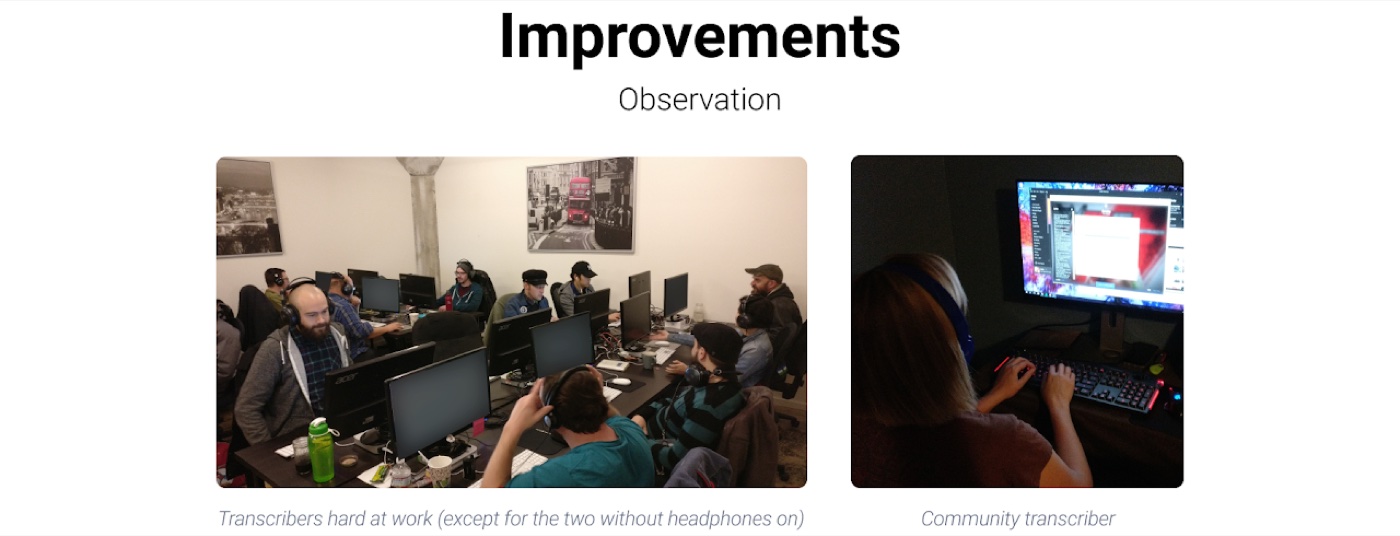
Research started in the room with the people doing the work. I spent time with both community and internal transcribers at their desks, headphones on, working through songs line by line, and talked with them directly about where the job actually wore them down. That observation sat alongside academic grounding: working memory, phonetic priming, game mechanics, semantic categorization, auditory refresh, and phonetic timing. Tools spanned Sketch, InVision, Amplitude, Sketchbook, Google Forms, MySQL, Excel, and no shortage of paper and sticky notes.
The outlook analysis that came out of it was blunt: minimize steps and process touches. That became the design mandate for the interface itself, cutting the workflow from 4 active apps and 7 hand-offs down to 1 app and 2: transcriber, then quality checker.
Data drove every decision
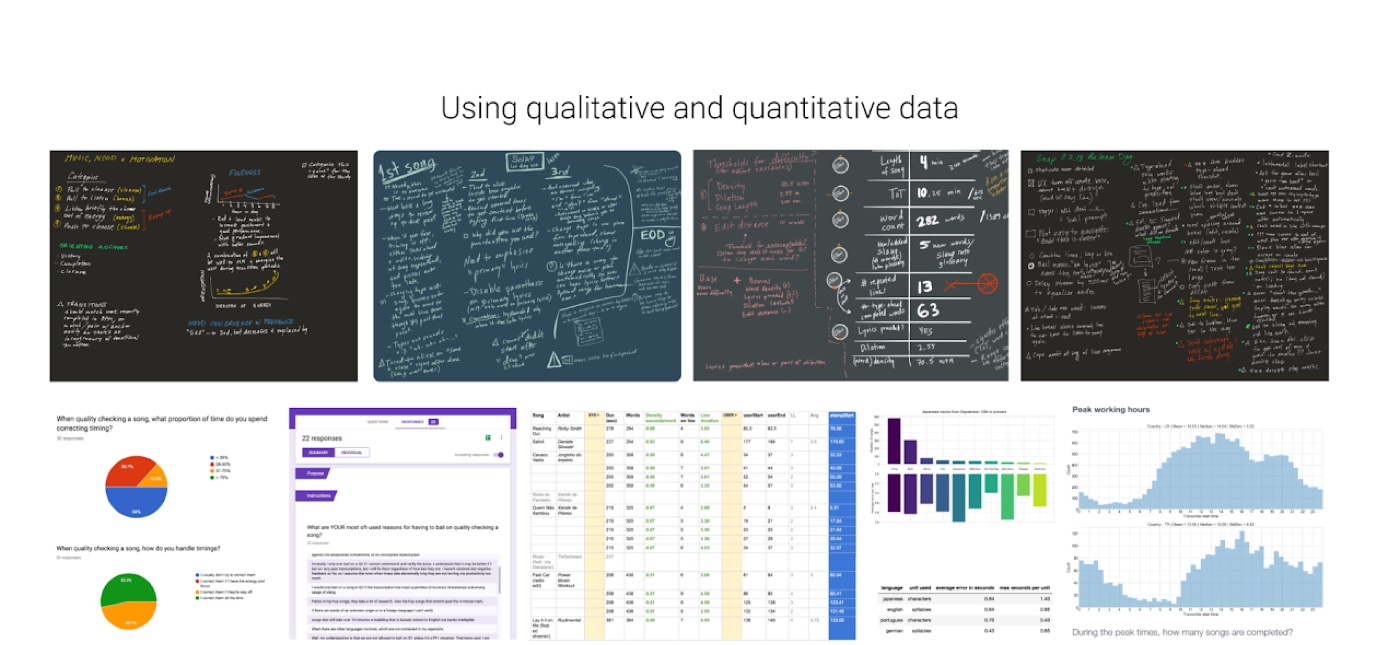
None of it stayed anecdotal for long. I surveyed transcribers directly on how they actually handled quality checking and timing, sorted findings on whiteboards by cause, working memory, phonetic priming, glossary friction, distraction thresholds, and pulled quantitative data per song and per language: word density, unknowns flagged, editing time, error rate per unit. I even charted peak working hours against completion rates to see when people were actually at their best. Every principle in the final design traced back to a specific data point, not a hunch.
That same rigor extended to how the work was priced. Apple Music's side paid a fixed rate per song. The transcriber's rate was calculated instead, weighted by song length, word density, and language difficulty, with a bonus above a quality threshold. Getting the incentive structure right mattered as much as any screen in the product.
A minimal, keyboard-driven prototype
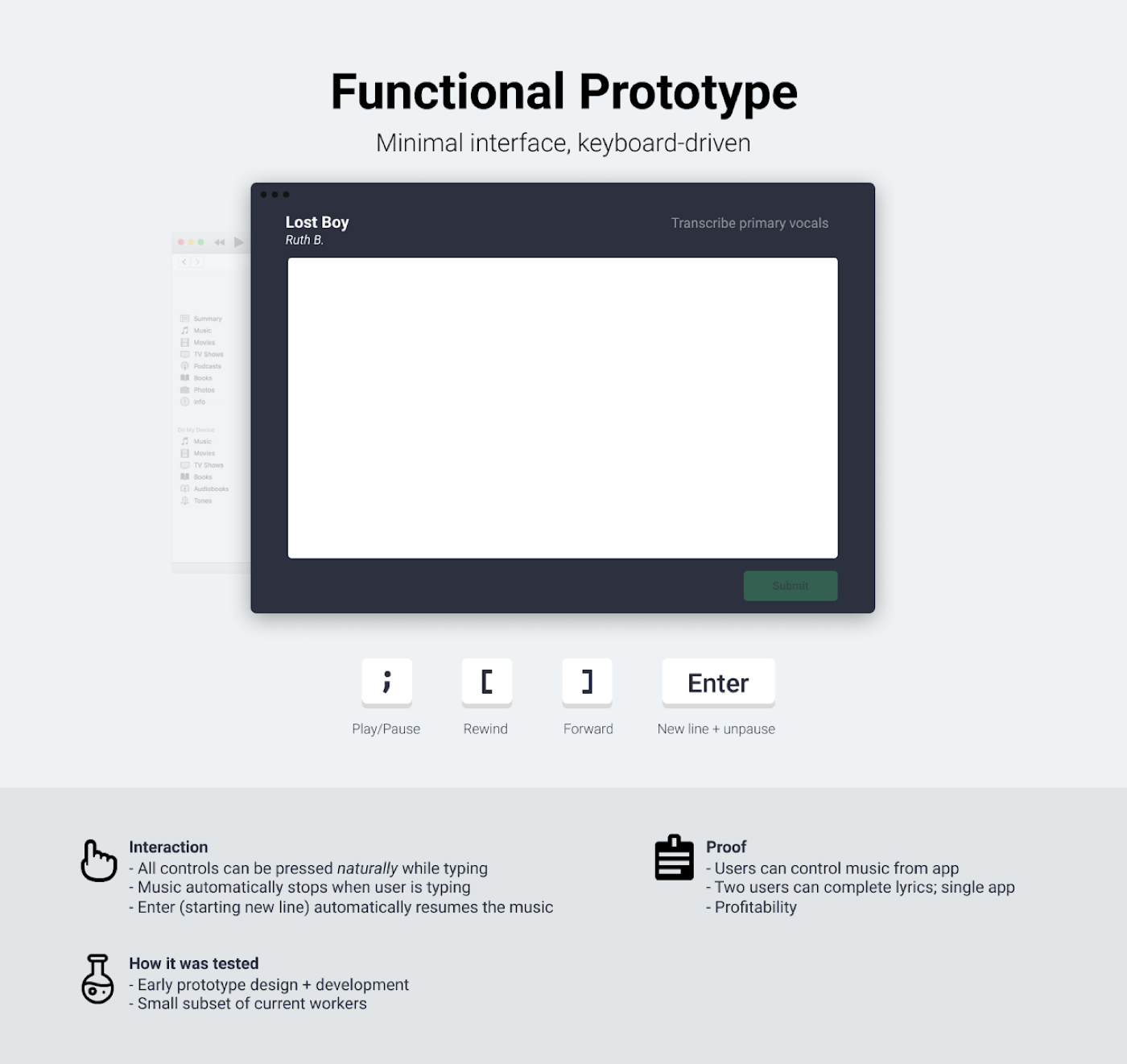
The functional prototype stripped the interface down to a single text field and a song title. Every control had a keyboard shortcut: semicolon to play or pause, brackets to rewind or fast forward, enter for a new line that also unpaused playback. All of it could be pressed naturally while typing, and music automatically stopped the moment someone started a line, so the goal was to keep transcribers' hands on the keys and their attention on the lyrics, not on the interface.
Early testing with a small subset of current workers proved out the core assumptions before the build went any further: users could control music entirely from the app, two workers could complete a full set of lyrics inside that single app, and the model held up as profitable at scale.
Psychology-driven design
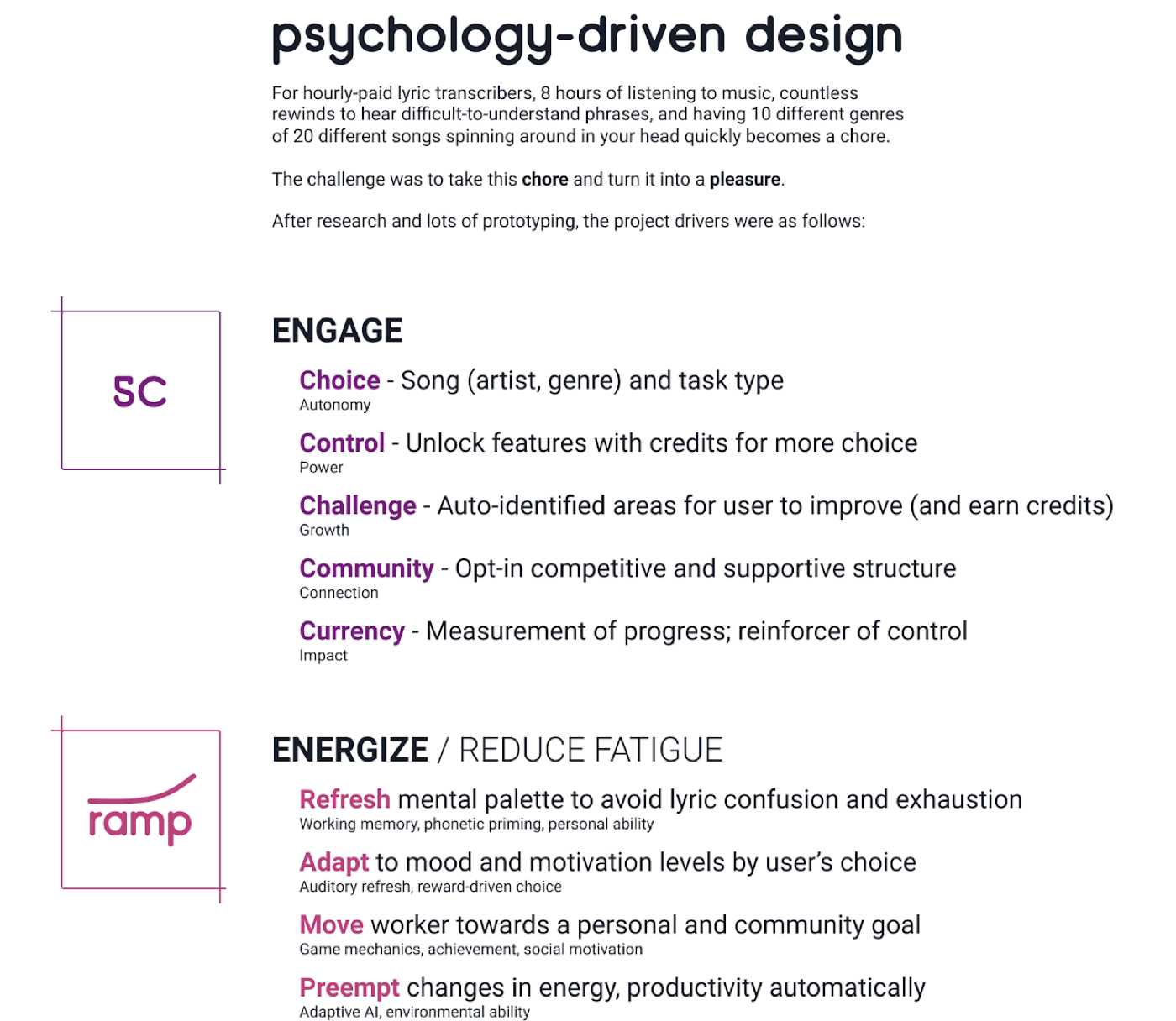
Rather than layer on generic gamification, the solution was built from mental health and optimization research plus direct observation of workers, around four principles:
- Refresh. Reset the mental palette to avoid lyric confusion and exhaustion, using working memory and phonetic priming.
- Adapt. Adjust to mood and motivation levels by giving workers a choice, using auditory refresh and reward-driven choice.
- Move. Point workers toward a personal and community goal, using game mechanics and social motivation.
- Preempt. Anticipate changes in energy and productivity automatically, using adaptive logic tied to environmental signals.
Underneath those four principles sat a second framework, the 5 Cs: choice of song and task type for autonomy, control over unlocking features with credits, challenge through auto-identified areas to improve, community through an opt-in competitive structure, and currency as a visible measure of progress.
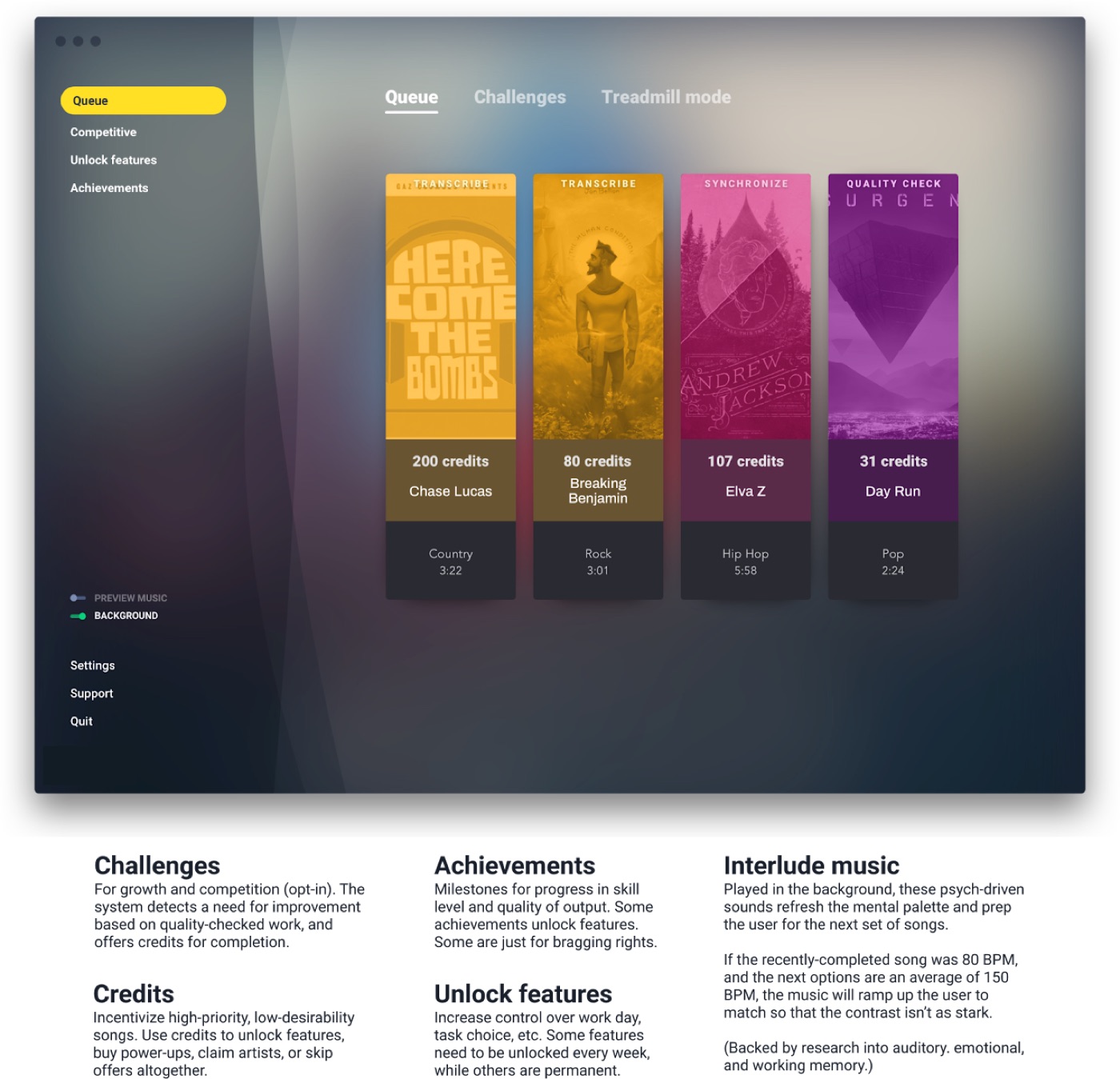
The resulting queue interface let transcribers choose songs by credits, genre, and length, competitive or solo, without turning the work into a slot machine. Challenges surfaced when the system detected a real need for growth on quality-checked work, and completing one paid out credits. Achievements marked progress in skill and output, some tied to unlocking real features, some purely for bragging rights. Credits themselves existed to incentivize the high-priority, low-desirability songs nobody wanted to pick up on their own, and could be spent to unlock more control over the workday, claim specific artists, or skip offers outright.
Even the music playing in the background was psych-driven. Interlude tracks refreshed the mental palette between songs and primed the worker for what came next: if the last song ran 80 beats per minute and the next queued options averaged 150, the interlude music ramped up to meet them partway, so the jump in tempo never felt jarring. It was a small detail, but it came directly out of the same research into auditory refresh and working memory that shaped everything else.
Iteration, testing, and feedback
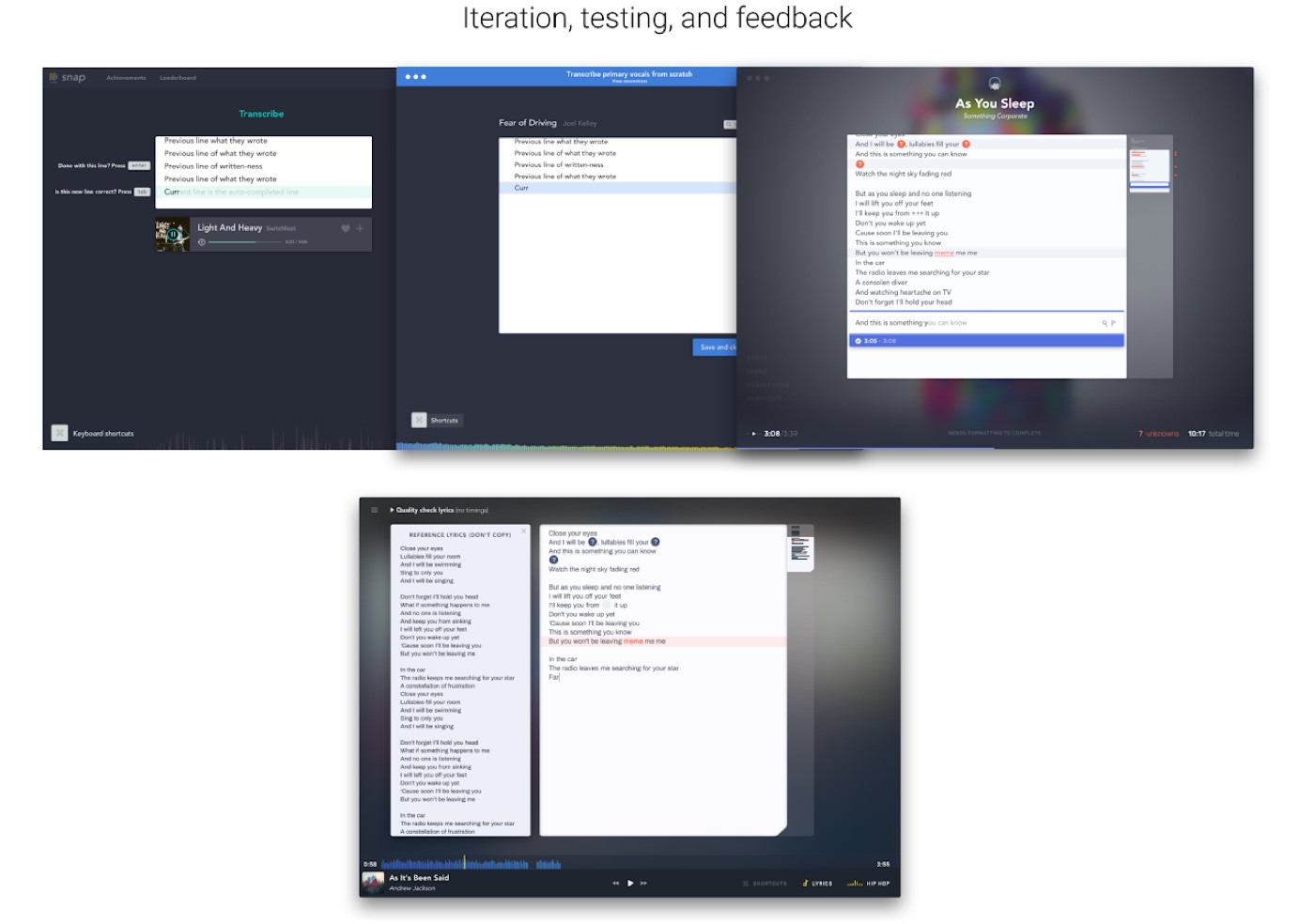
The interface went through several working prototypes before any of it reached the full workforce. An early version, built inside a gamified shell called Snap, tested whether achievement and leaderboard mechanics held attention on their own. A more stripped-down build tested pure transcription flow against a waveform and a running word count. A third, styled around a real release, tested inline unknown-word flagging and quality-check timing against a reference lyric set. Each round shipped to a small subset of current workers first, and each round changed something before it went any further.
Outcome
The redesigned experience extended the average worker's productive window by two hours a day on what had been repetitive, fatiguing work, measured through research, direct behavioral observation, and prototype testing. The same research also informed a redesign of the distributed workforce marketplace, making task reservation and completion faster for freelance workers.
+2 hrs
Average daily productive window extended, on repetitive transcription work
4 → 1
Active apps needed to complete the workflow
7 → 2
Process hand-offs, down to transcriber and quality checker